
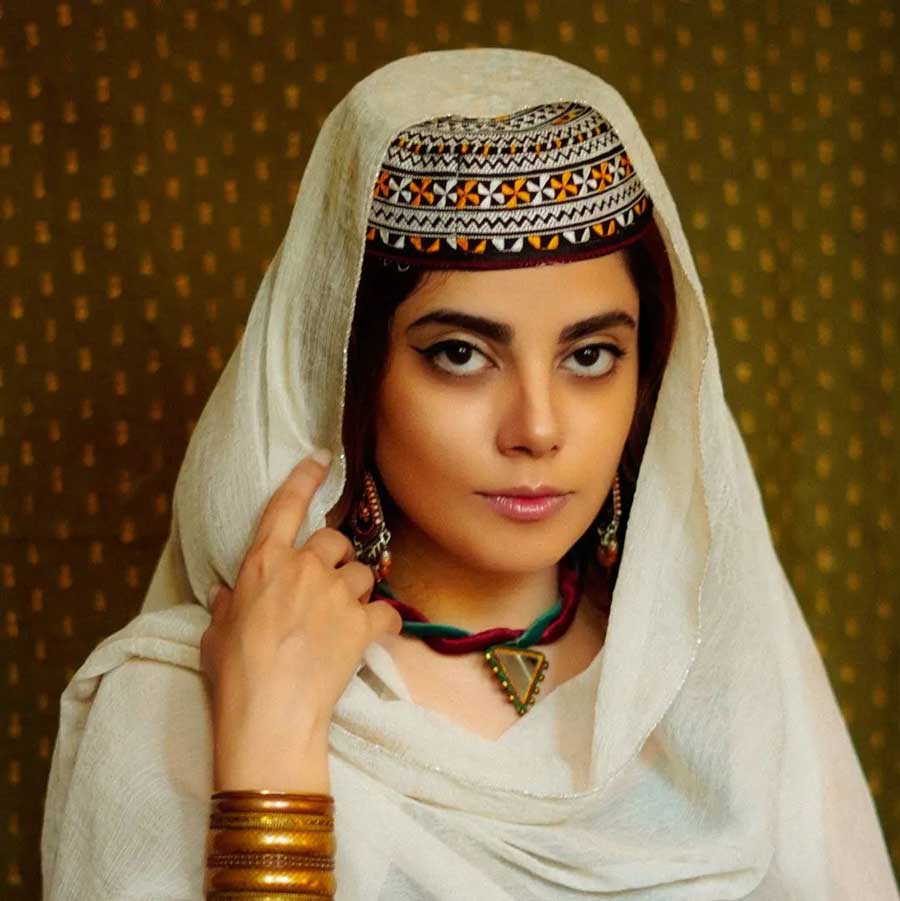
A hat from the far-lands by Niloufar Ashournia
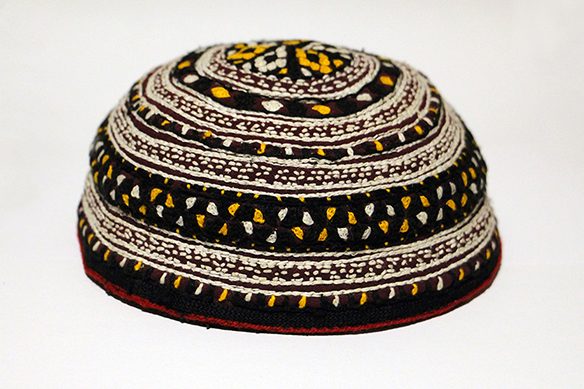
I am passionate about collecting old and traditional clothing and handicrafts. Accessories, fabrics, carpets, quilts, tapestries, decorative pieces, books and anything that catches my eye at second-hand markets and has a traditional Persian touch. Most of the time I just collect them and do not use them at all. Often, I do not even know their exact purpose and just like the way they look. Like this hat (Fig.2). When I bought it, I thought I was buying a traditional Iranian embroidered hat (very general term). To be specific, I had bought one of the authentic and deeply rooted symbols of Turkmen culture “Takhya”.
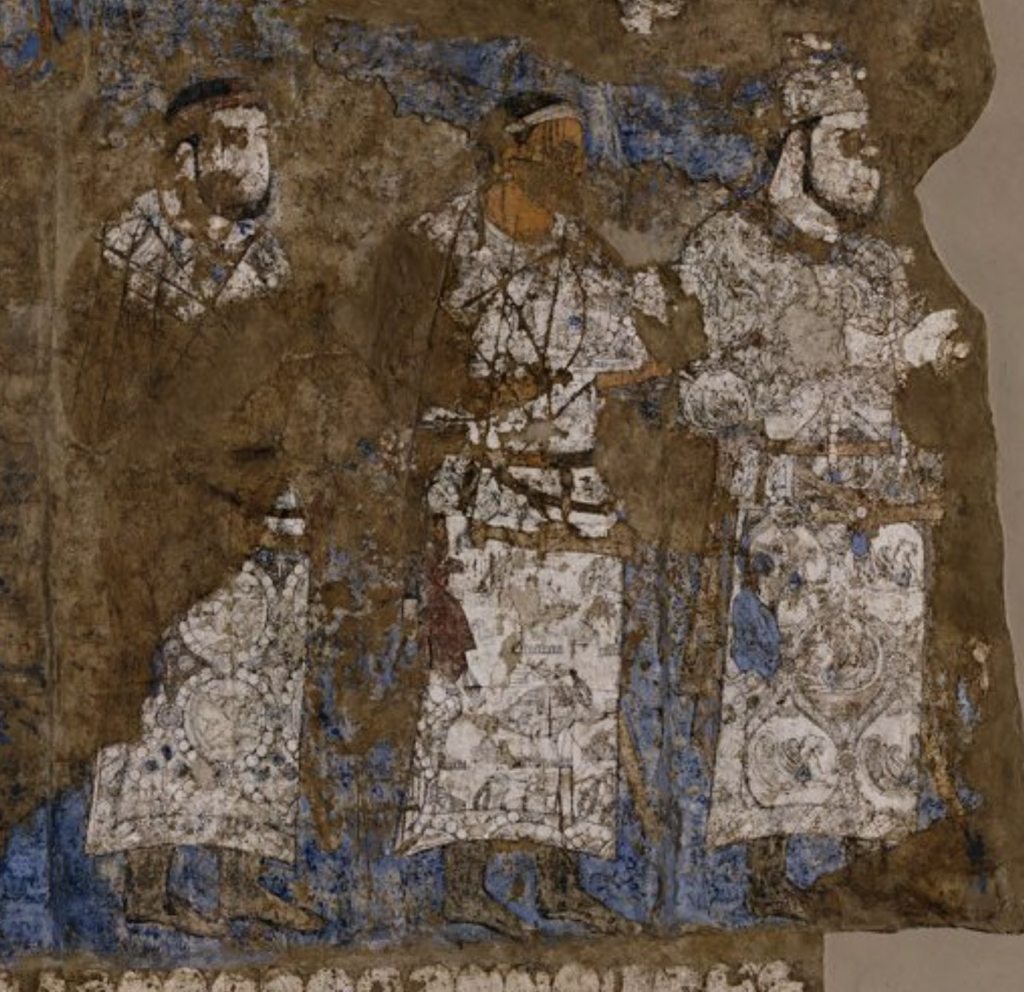
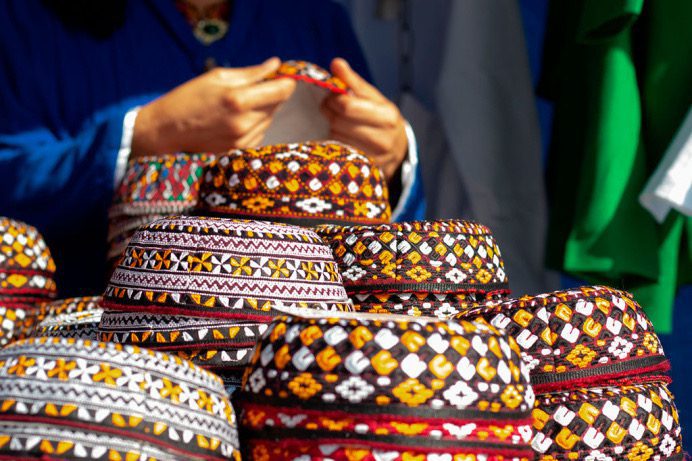
Takhya is the name of a special type of headgear in the form of a small cap -a skullcap – worn by all the peoples of Central Asia, as evidenced by wall paintings from the 8th century AD. (Fig. 3) In Turkmenistan it is called takhya (tahýa). The Uzbeks call it tyubeteika, duppi or do’ppi, the Kazakhs call it takiya or tobetai. The Kyrgyz call it topu or takiya and the Tajiks toki. In many Muslim countries, this type of skullcap is also called Kufi. This skullcap is made of different materials in the tribes and religions of Muslim countries, but despite the differences, the Kufis are as widespread as the geographical extent of Muslims, from North, East and West Africa to South and Central Asia. (Taqiyah_(cap))
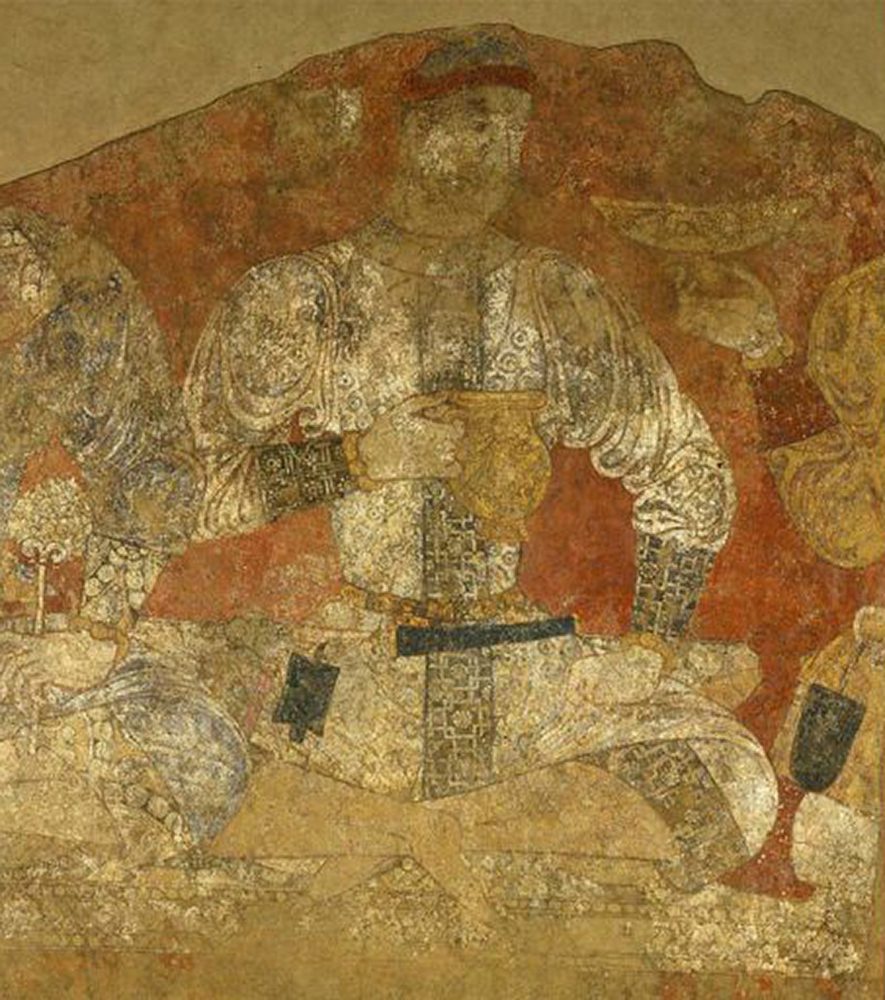
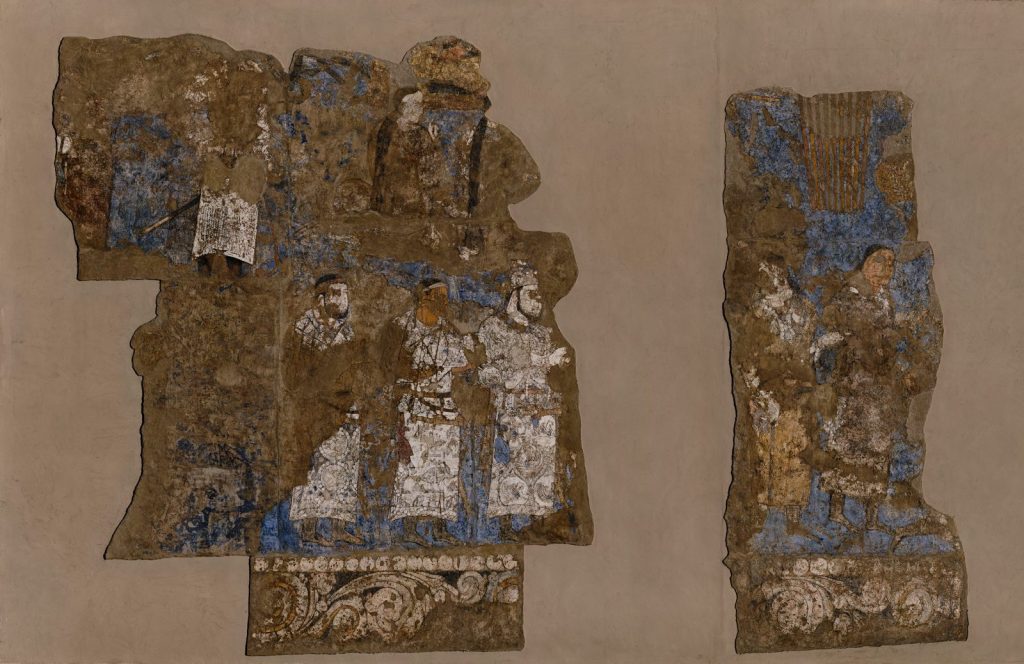
The wearing of these hats is a cultural and religious matter, depending on the nationality and religion of each nation It can have completely religious purposes, for example, it is said that the Prophet Muhammad covered his head with a hat, and as Muslims it is praiseworthy to imitate him. (Kabbani Questions on Islamic dress and head-dress for men (Libas Wal ama’im)) Therefore, groups of Muslims wear special hats on special occasions or during worship.
On the other hand, wearing these hats can also have a national, ethnic or cultural aspect. Such as some designs that symbolize the unity of the Turkmen horse riders, belonging to a certain nation and group or marital status. (Refer to “When it comes to symbols and their meanings”.)
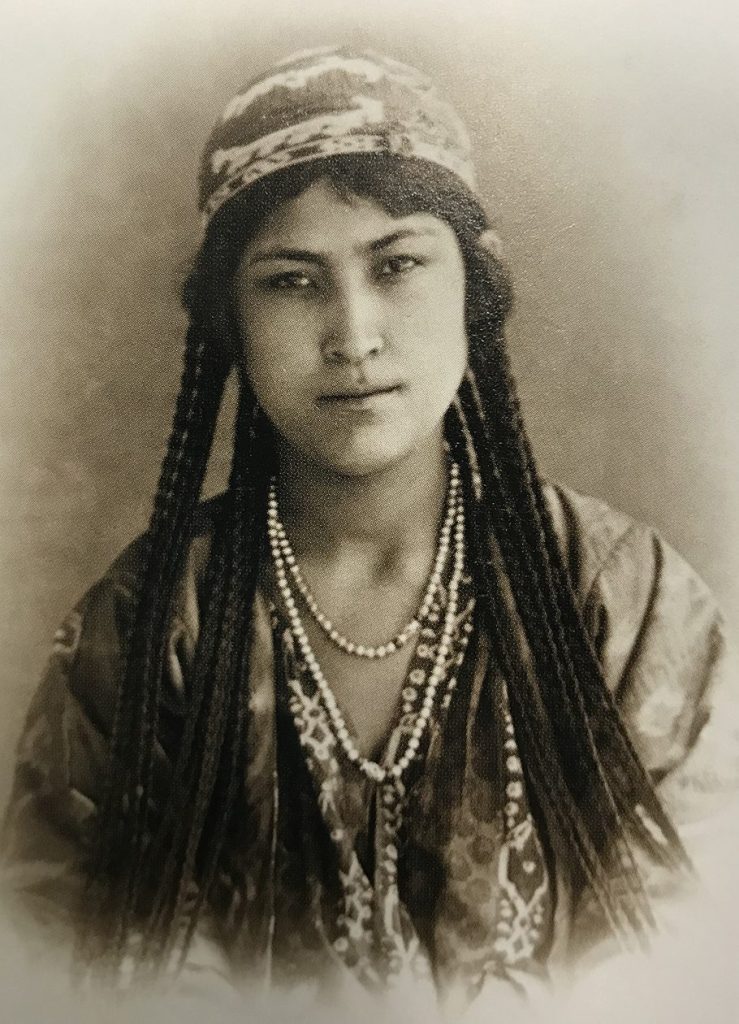
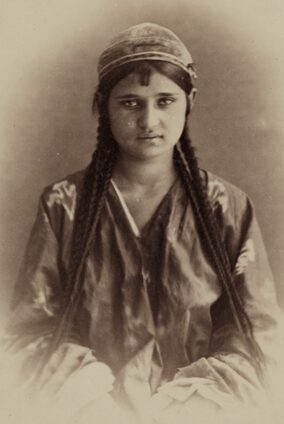
On the territory of Turkmenistan, the skullcaps of many ethnic groups differed in size, style and, above all, ornamentation, although at first glance they all appear to be the same.
Takhya is an indispensable and special part of traditional Turkmen clothing. In the 19th century in Central Asia, the nation, tribe, region or even the city a person came from could be recognized by the pattern and style of their headdress. (Meller et al. Headwear 135)
In the second half of the 20th century, the old takhya had almost fallen into disuse, but today it has been reborn without being influenced by modern fashion trends or new decorative materials and techniques. Nothing could erase the traditional headgear from Turkmen life and it is very much in demand today, both among adults and children, in combination with national clothes and modern clothing. ( You can find different types of takhya here.)
On the one hand, Takhya has a very useful function – to protect the head from the scorching sun, and on the other, it adorns it. But wearing takhya also has another purpose. In ancient times, these colourful hats had the meaning of a talisman and magic. Turkmen people believed that the takhya protected its owner from all kinds of problems and protected the wearer from the evil eye, evil sprites, illness and difficulties. According to ancient customs, even an old Takhya could not be given away or thrown away. (turkmen.ru Возвращение тахьи)
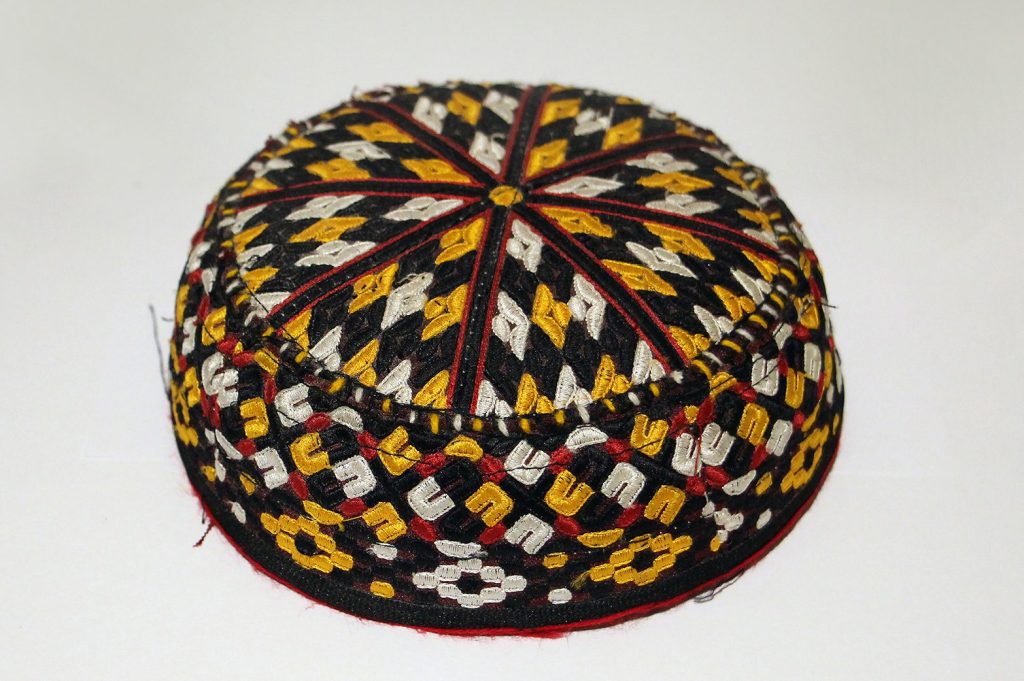
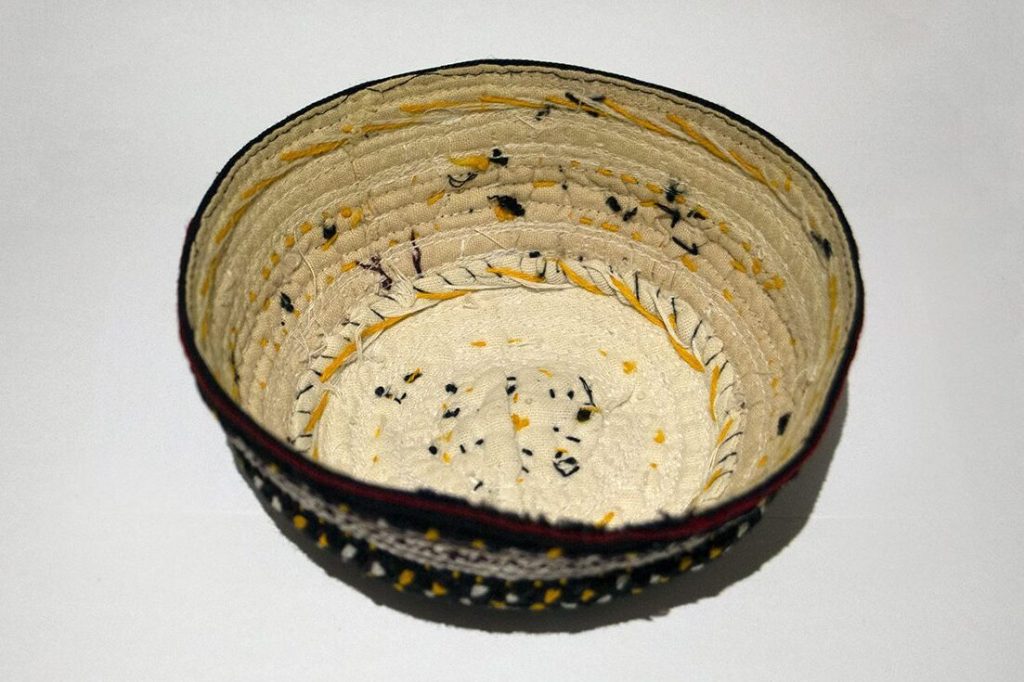
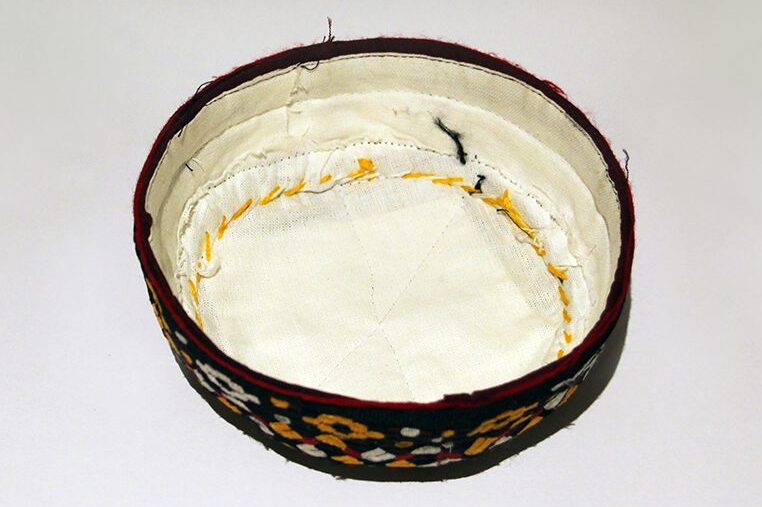
I have two different designs of women’s Takhyas in two different sizes because I didn’t pay attention to the sizes when I bought them. One of them (Fig.8) is completely handmade, the sewing of the hat body and its embroidery are completely done by hand. Another takhya (Fig.9) is embroidered by machine and then the embroidered parts are sewn by hand. The first shape is a hemisphere and the second shape is a short cylinder. The embroidery pattern of both shapes is a traditional Turkmen pattern called Kesdi.
In the following, we will analyze and review both Takhyas in the form of my overall view from the article “From value to desirability: the allure of worldly things”, we will analyze and compare them (the ones that I owned) in general below.

What are the Takhyas made of?
In terms of shape, Takhyas are divided into round, oval, hemispherical and low and high heights. They are usually sewn from different fabrics, the expensive ones from velvet and keteni silk and the simpler ones from linen and muslin, but often from the beautiful expensive fabric “keteni silk”.
Due to the favourable climatic conditions in the region, the Turkmen have been very successful in mulberry cultivation and silkworm breeding throughout history. (Khaidova Keteni Silk Fabric) For this reason, they have always been able to produce very durable and beautiful silk fabrics.
Keteni is a highly demanded and popular fabric, not only for sewing and making traditional Turkmen clothing within the country, but the results of archeological excavations show that this magnificent fabric has found its way to Europe via the Silk Road for centuries. (Khaidova Keteni Silk Fabric)

One of the most important characteristics of Keteni fabric is its colour quality. In ancient times, the fabric was dyed with natural and vegetable dyes, which meant that the specific intensity of the hue and the stability of the colours were very high.
The artisans still use the ancient loom (Tara), a basis for the fabric which made of stiff silk fibres. Its width is about 30-40 cm, which is determined before the clothes are cut. Once the time-consuming process of preparing the fibres is complete, the long silk threads are pulled onto the loom. The craftsman quickly pushes the rug from side to side, knots the threads tightly and the keteni is finished. Today, the production of keteni silk is just as professional as it was in the old days. And the women still make and wear clothes from Keteni fabric, which underlines their uniqueness and cultural identity.
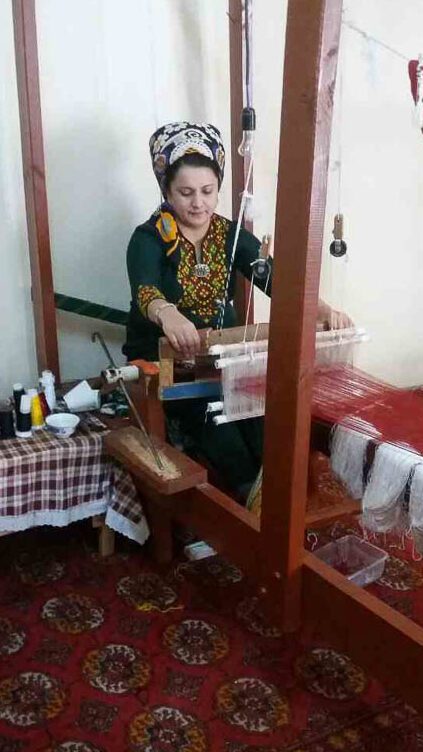
When they start working on the loom, the artisans pray to an ancient goddess Ashe Patma (a pre-Islamic goddess specific to Central Asia and Turkmenistan who was the patroness of the craft and artisans), to bless their hard work. (Shirazi Blessed looms, blessed fibres 54-55)
Keteni is one of the most luxurious fabrics used to make Turkmen skullcaps. My two Takhyas are the simpler types both made of muslin. One of them is made of lightweight fabric and the other is made of thicker type.
How are these skullcaps so precious and exclusive?
At first glance, it seems that takhya is very simple in terms of form and decoration and is easy to make. But this is completely wrong, because making takhya is very difficult. It takes a lot of patience, effort and time to cut and embroider a small hat. The wide silk weave “Jahak” that forms the frame of the takhya, for example, is woven by two craftswomen at the same time, so that all fingers are used. In order to create patterns and ornaments, the surface of the hat is so densely filled with embroidery that it is sometimes impossible to tell what colour the base fabric was with the naked eye.

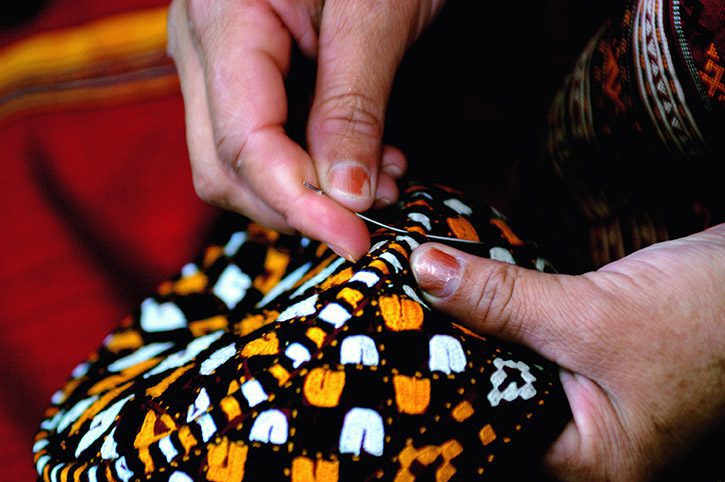
The Turkmen are very strict in their customs and traditions, which is also reflected in their clothing traditions. To illustrate: the motifs on modern takhya are still the same as they were centuries ago and have not changed. But not because inventing and designing new embroidery motifs is a difficult task, but because the artisans have perfected these motifs over the course of a long history and their evolved form is rooted in the heart of Turkmen culture. The patterns and motifs of the decorations as well as the technique of embroidery are completely different among the various Turkmen ethnic groups and, as already mentioned, this is one of the distinguishing features of the owner’s ethnic group. However, all takhyas have one thing in common: the takhyas, artistically embroidered with silk threads, can rightly be considered original works of art.
Nomadic, rural and urban traditions are very creative when it comes to decorating the surface of plain fabrics with embroidery. This level of creativity reaches its peak in Central Asia, where the art of embroidery is an integral part of the culture and the different patterns and colours are as diverse as the roots of the ethnicities of the seamstresses. (Harvey Applied decoration 113-119)
As mentioned earlier, one type of stitch usually dominates the embroidery of a particular tribe or group. Kesdi is a type of lace stitch widely used by the Turkmen – it was also embroidered in my hats – and silk stitch forms the geometric motifs of mountain embroidery, sometimes accented with white beads. (Fig.16)
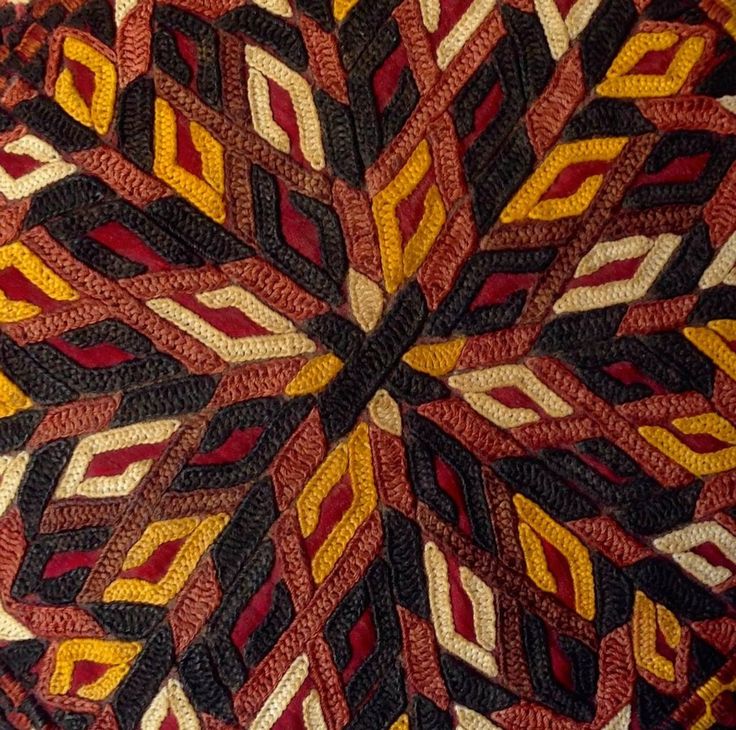
Two different techniques are used to embroider my Takhyas. In one (Fig.8), the silk kesdi embroideries are completely handmade and the lining fabric is lightweight muslin. In the other (Fig.9), the embroideries are also the kesdi but designed with the computer and transferred to the fabric with embroidery machines and then stitched together by hand. Of course, the first variant is more valuable.
Comfortable also Practical
A few days after birth, a soft takhya with thin seams made of linen fabric is made for the child. For the elderly, hats are made of white cotton. And these two groups, old people and newborn children, wear the simplest, softest and lightest type of takhya due to the greater sensitivity of the skin. Men wear a takhya on their shaved heads, which in the past was mainly part of a complex headdress that served as the main base and fulfilled auxiliary functions (Turkmen Yashuli-translated from Turkmen means “Long-Lived”-wore them under their hats). This is because its soft material and delicate fabric acted as a protection and barrier. But today’s generation of Turkmen men see the takhya as an independent headgear. Generally, simpler takhyas are used as everyday hats that can be worn on hot days and under the sun due to their lightweight fabrics and breathable natural fibres.
The feeling of comfort and softness that my Takhyas give is almost the same. But in the first one (Fig.8) with lightweight muslin lining and finer material is softer and more comfortable.
When it comes to symbols and their meanings
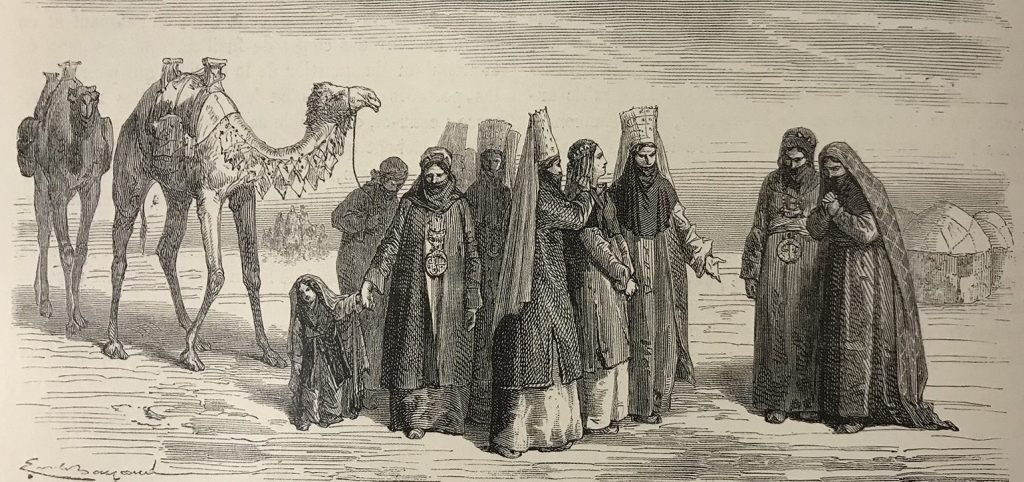
In Turkmen clothing, there is a clear distinction between the head covering of girls and women, and in society these coverings completely distinguish them from each other.
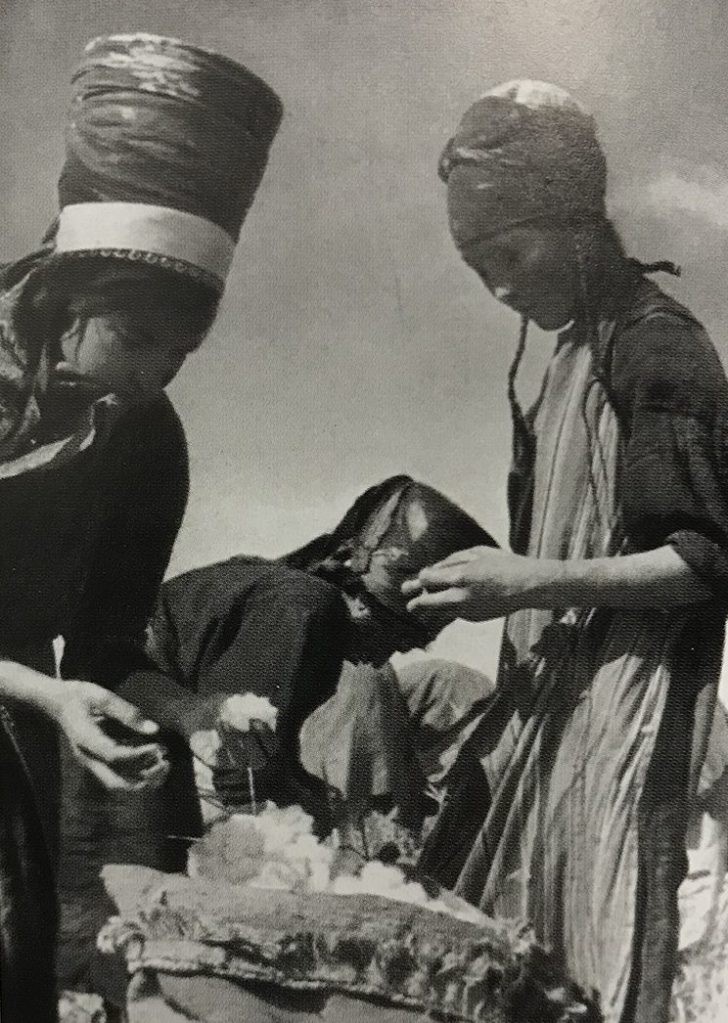
Girls and brides wear a soft takhya made of coloured silk threads with silver pendants and a small silver dome “gopba”. In the past, bird feathers were pinned to the top of the dome’s pointed tip, which served as a talisman. Takhya emphasized the beauty of a girl, and the embroidery on the girl’s takhya was a symbol of beauty and virginity.
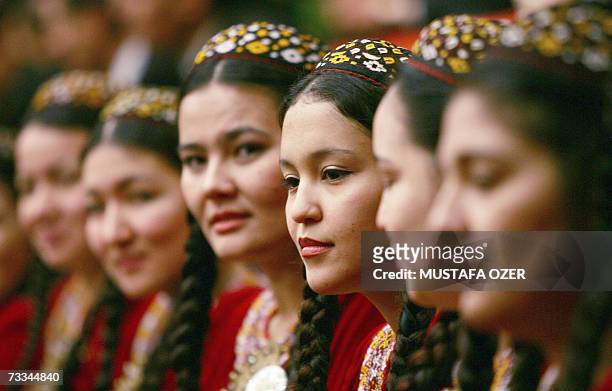
In the past, Takhya gave information about a girl’s honour, and the absence of Takhya was tantamount to a violation of chastity. The girl made centre-parting hair and braided on both sides of her face. At the same time, two braids were placed in the front to cover her chest as if to protect it from the prying eyes of indecency.
After marriage, the woman could wear her girl’s clothes, but some elements, including the girl’s Takhya, were permanently removed from her clothes, and she never wore a colourful Takhya again nor wore her braids down like a girl.
The difference between the male and female takhya lies in the simplicity and limitations of the male version. However, the male takhya has its own embellishments which are a form of encryption. Along the entire surface of the male thallus are bands of small triangles in several rows, close together. This symbolizes the unity of the Turkmen horsemen, who are ready to push back the enemy and stand shoulder to shoulder.

Not only is takhya itself symbolic, but its colour also contains concepts. For example, the red colour is very important in all kinds of Turkmen embroidery, including the embroidery on hats and Takhyas. According to the Turkmen, the special red colour extracted from the Madder root has magical properties and protects against evil forces, and it brings health and good luck, especially to children and girls of childbearing age.
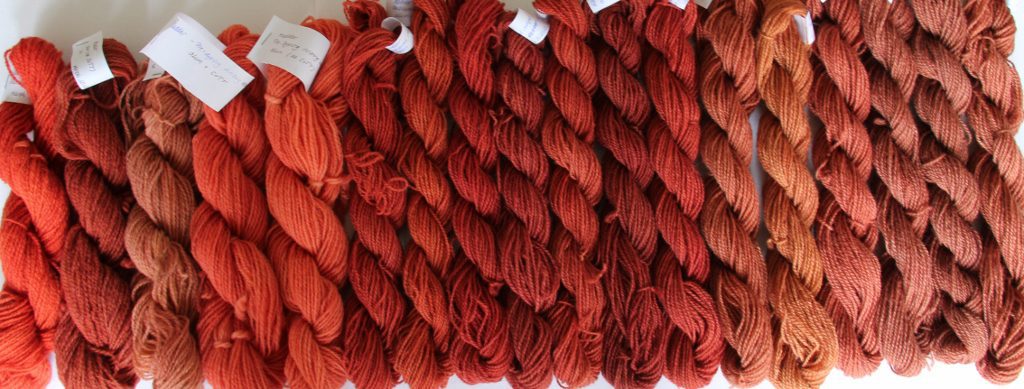
Both of my Takhyas are specific to unmarried girls because they are shorter than the models for married women. As I mentioned earlier, there is a clear distinction between the head covering of girls and women and married women wear traditional tall headdresses. (Fig.17)
Takhya as a commodity
Apart from the Takhyas, which are sewn by nomadic women or mothers for their young children, most skullcaps are made by women artisans and sold in the markets. The important point is that this type of embroidery is the only one of its kind that is allowed to be sold by women in the market and has its own section in the market.
Other types of embroidery are made by the women personally for themselves and their families and are not allowed to be sold on the market to strangers. This is why Takhya embroidered by Turkmen women are so valuable. Despite their value, they are not very expensive.
Although their price depends on the purchase method. If they are purchased from manufacturers, their prices are very reasonable, but they are sold more expensively in international markets.
As already mentioned, a takhya cannot be separated from its owner, it cannot be thrown away and passed on to another person. However, there is one exception: Takhya is passed on from one person to another only in one case, and that is part of the wedding ritual.
After the wedding, in the “Bessalma” ceremony, the girl’s Takhya is separated from the bride, the four braids are cut in half and thrown behind her head and tied together with a beautiful silver heart called “Asik”. The ceremony of changing the headscarf on the wedding day is particularly important. This ceremony was splendid, funny, loud and accompanied by a symbolic fight between the women and girls for the bride. The young woman’s friends make one last attempt to prevent her from being taken away by the women of the groom’s family, but as always, the women win this symbolic conflict and the bride now goes to their camp. Then a string of colourful lace, the “Ajah”, is thrown over the young woman’s wedding cloak. The groom pulls the reins three times, as if he is about to cut off the girl’s head. The bride’s head is then covered with a large white shawl donated by a respected woman and several children, and the Takhya is given to the groom’s younger sister. (turkmen.ru Возвращение тахьи)
The significance of this ancient ritual is that, according to ancient belief, the favor of the owner of Takhya should go to another girl so that she marries safely and gives birth to many children, because the main task of a woman is to be a daughter, a wife, a mother and a continuer of the family. They hand Takhya over to her new owner with wishes: “Sanada toy etmek nesip etsin!” (“You may have a wedding too!”) (turkmen.ru Возвращение тахьи)
Creative Component
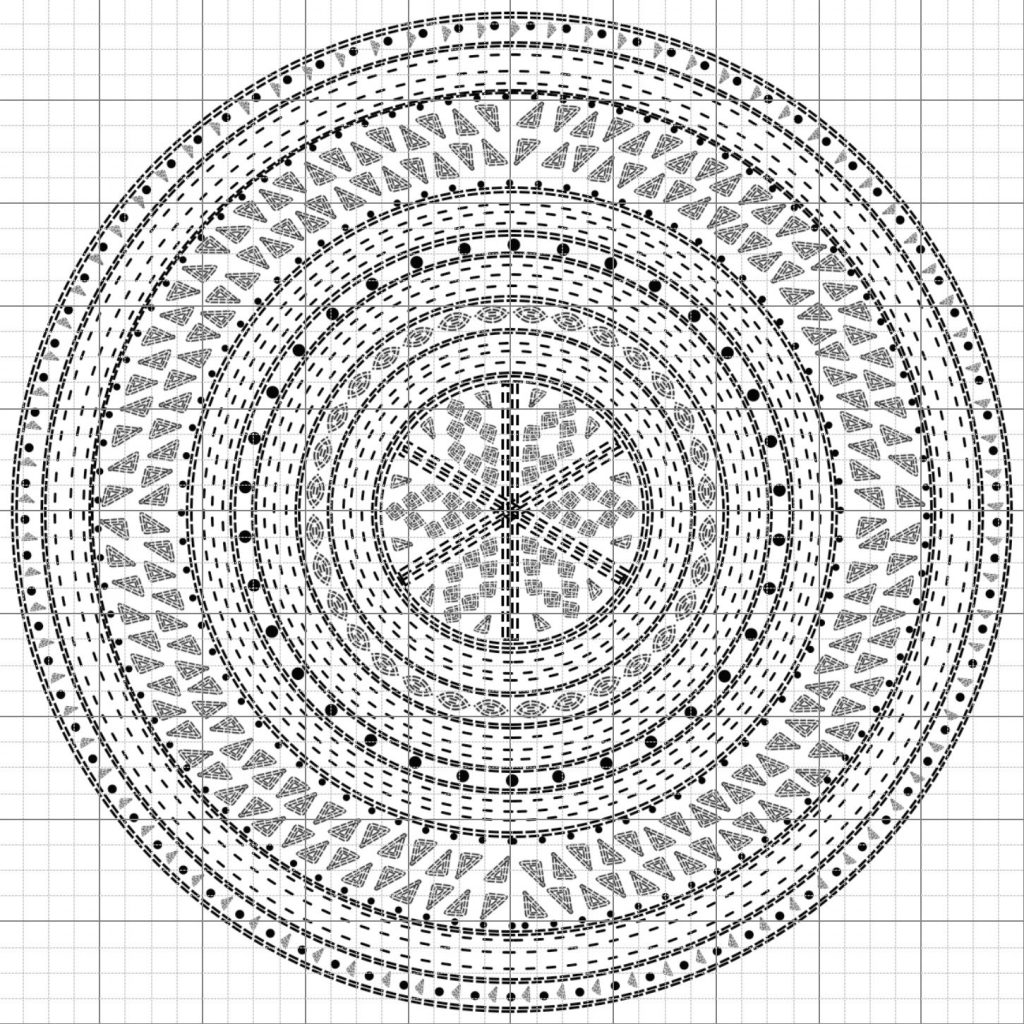
While researching the history of the takhya, I decided to recreate the pattern of my Takhya on the computer using Adobe Illustrator. During this restoration, I noticed many details in the seemingly simple pattern. Surprisingly, it took me a long time to draw it and this experience made me appreciate the handiwork of Turkmen women even more.
To conclude, the takhya, a simple skullcap, is an important part of Turkmen culture, which, in contrast to its apparent simplicity, is full of special details and symbols. Each of the Turkmen ethnic groups embroider their own motifs on the takhya, representing their affiliation to their society. In general, the customs of the indigenous peoples of each region are very special and rich. If the elements of their daily life are carefully examined, one can discover a lot of information about their culture, art and beliefs that are very valuable and thought-provoking.
Works Cited
Back to School Bazaars Open in Turkmenistan. 2 Aug. 2019. Business Turkmenistan , https://business.com.tm/multimedia/4198/back-to-school-bazaars-open-in-turkmenistan. Accessed 5 Dec. 2023.
Bairieva, Ajap. “Homespun Silk.” TURKMENISTAN: All Interesting Facts and Information, 5 June 2006, countryturkmenistan.tripod.com/index.blog?start=1150697382. Accessed 05 December 2023.
Bellemare, Julie, and Judith A Lerner. “The Sogdians Influencers on the Silk Roads.” THE SOGDIANS AT HOME Art and Material Culture, sogdians.si.edu/the-sogdians-at-home/. Accessed 20 Dec. 2023.
Brazill, Linda. “Central Asian Embroidered Hats – Each Little World.” Each Little World, 17 Mar. 2009, https://www.lindabrazill.com/each_little_world/2009/03/central-asian-embroidered-hats.html. Accessed 07 December 2023.
Gillow, John. “Central Asia,Turkmenistan.” Textiles of the Islamic World, Thames & Hudson, London, UK, 2015, pp. 203–204.
Harvey, Janet. “Applied Decoration.” Traditional Textiles of Central Asia, Thames and Hudson, New York, NY, 2009, pp. 113–119.
Heidi. “Madder, in Many Ways.” Sea Green and Sapphire-A Blog about Textiles and Colour, 18 Apr. 2012, seagreenandsapphire.wordpress.com/2012/04/18/madder-in-many-ways/. Accessed 05 December 2023.
Kabbani, Shaykh Muhammad Hisham. “Questions on Islamic Dress and Head-Dress for Men (Libas Wal Ama’im).” The Quran Blog – Enlighten Yourself, 24 June 2010, thequranblog.wordpress.com/2010/06/24/questions-on-islamic-dress-and-head-dress-for-men-libas-wal-amaim/.Accessed 21 December 2023.
Khaidova, Tavus, and Leili Khaidova. “Keteni Silk Fabric.” The Encyclopedia of Crafts in WCCAsia Pacific Region ECAPR, 23 Nov. 2018, encyclocraftsapr.com/keteni-silk-fabric/. Accessed 12 December 2023.
Kun, Aleksandr L. Tajik Woman: Sharafet-Bibi.
31 Oct. 2021. Library of Congress, Central and South Asia, https://loc.gov/pictures/resource/ppmsca.14288/. Accessed 12 Dec. 2023.
Kun, Aleksandr L. Types of nationalities in the Turkestan krai. Tajik Women. Maina Ai. 1865. Library of Congress, Central and South Asia, https://loc.gov/pictures/resource/ppmsca.14289/. Accessed 12 Dec. 2023.
“Majestic Image of Goddess Carried through Centuries.” Turkmenistan Altyn Asyr, 30 July 2012, turkmenistan.gov.tm/en/post/1119/majestic-image-of-goddess-carried-through-centuries. Accessed 27 Dec. 2023.
Meller, Susan, et al. “Headwear.” Silk and Cotton: Textiles from the Central Asia That Was, Abrams, New York, NY, 2013, pp. 135–139.
Miras. keteni. 11 Apr. 2021. Turkmenmetbugat, https://www.turkmenmetbugat.gov.tm/tk/magazines/13/articles/25591. Accessed 15 Dec. 2023.
OZER, MUSTAFA. Turkmen girls attend President Gurbangul. 2007. Getty Images, Ashgabat, https://www.gettyimages.ca/detail/news-photo/turkmen-girls-attend-president-gurbanguly-berdymukhammedovs-news-photo/73344840?language=fr. Accessed 10 Dec. 2023.
Shirazi, Faegheh. “Blessed Looms, Blessed Fibers.” Talismanic Textiles: Gender, Status, and the Supernatural, Bloomsbury Visual Arts, London, UK, 2023, pp. 54–55.
“Taqiyah (CAP).” Wikipedia, Wikimedia Foundation, 13 Dec. 2023, en.wikipedia.org/wiki/Taqiyah_(cap).
“Возвращение Тахьи.” Turkmen, 2014, turkmen.ru/node/53.Accessed 05 December 2023.
 niloufarashournia.com